
The best companies now recognise that customers are their biggest asset. With no customers to buy our product. We have no business at all. People who have a positive customer experience are more likely to spend more with our brand, pay a premium for our service, and recommend our brand based on the experience we deliver.
People who change to another brand are more likely to do so because of poor service, and they are equally likely to broadcast this.
Fragmented understanding of customers is common in organizations where KPIs are assigned and measured per department. Many companies do not piece together the entire experience from the user’s standpoint. A shared vision is a critical aim of journey mapping – without it, agreement on how to improve customer experience will never happen.
Customer journey vs customer lifecycle
Customer journeys are created from a users perspective – a lifecycle focuses on the brand perspective.
A lifecycle is made of labels that describe a specific state: Unaware, Prospect, Customer, Advocate
Journeys are broken down into phases of activity across touch points; Discovering, Researching, Comparing, Consumption etc.
Customer journey actions
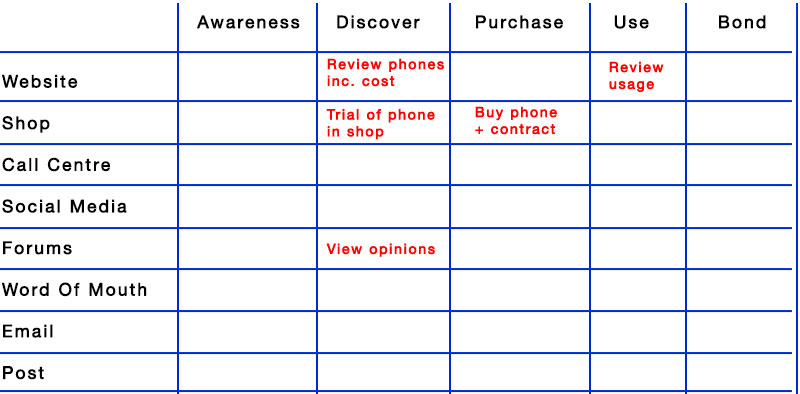
There are multiple touchpoints between your customers and your business. Each action and activity can be summarised into the following classic types:
Awareness
Discover
Purchase
Use of product of service
Bonding with product
Customer journey map
With your customer touchpoints and activities completed a table can be created that maps your customers journey with their activities. eg Thinking of purchasing a phone.
Customer journey narrative
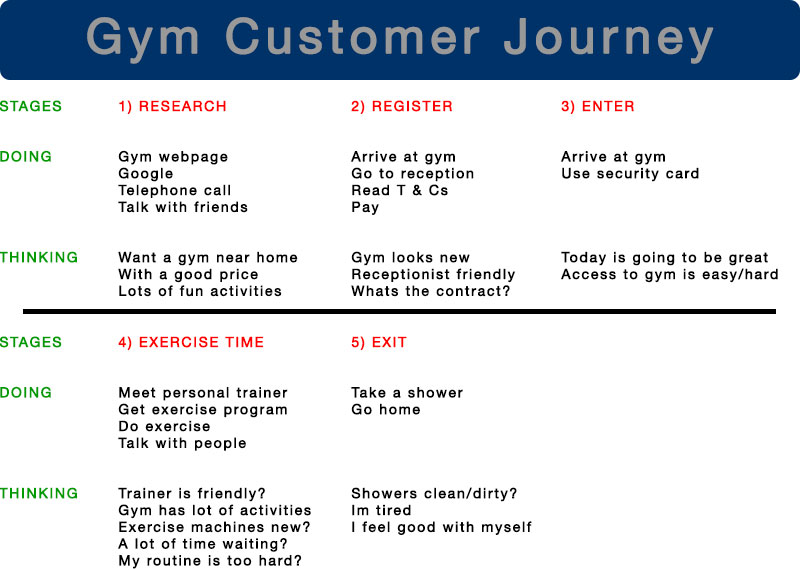
To help diagnose issues with our products we can map out the journeys users take to perform certain actions in a narrative form. Eg signing up for a gym for the first time.
Fixing the gaps
Once negative experiences have been identified – create an action plan to fix them. For each gap define the ‘current state’ and identify a target ‘future state’. If customers checkout process is now 6 steps, set a target that is considered an improvement.
An action plan should demonstrate the customer journey from current state to future state. If you want to reduce checkout to 4 steps, what actions are needed to achieve this future state? For each pain point you can create a simple 3-column table to document the transition.
